
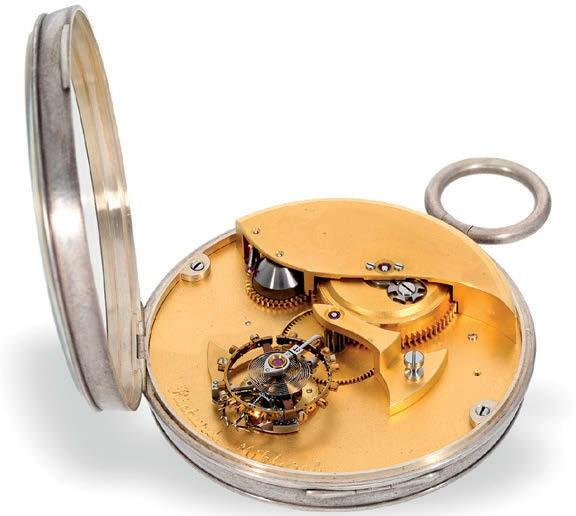
Tourbillon-watch by Richard Miklosch, €900,000 (£782,610) at Cortrie.
From the 1970s until well into the 1990s Miklosch, who was self-taught, built a number of ‘flying tourbillon’ watches, which very rarely make it to the market.
Unlike the other two legendary 20th century makers of this ultimate type of precision watch, George Daniels and the Swiss maker Thomas Engel, who both worked in the tradition of Abraham Louis Breguet, Miklosch was inspired by watches from Glashütte, the centre of the German precision watch industry from the second half of the 19th century onwards.
Breguet invented and patented the tourbillon in 1801. The principle was to house the escapement in a rotating carriage or cage and thus compensate for changes in the position of the watch which could affect its accuracy.
In the 1920s, Alfred Helwig of the Glashütte Watchmaking School developed his version of the tourbillon, the cage of which was supported on only one side, giving rise to the name ‘flying tourbillon’. Miklosch was inspired by this work and in the years before his death in 1974, Helwig helped him with the construction of his own watches.
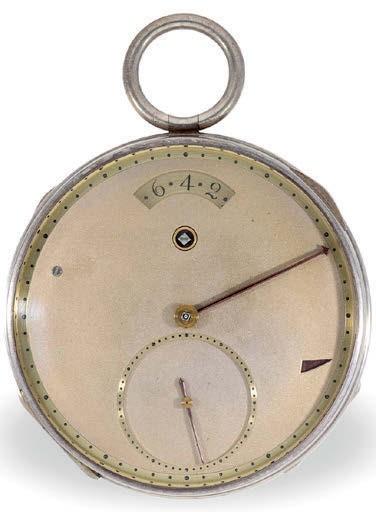
Tourbillon-watch by Richard Miklosch, €900,000 (£782,610) at Cortrie.
The example in Hamburg, completed in c.1995 and fitted with a detent escapement, was clearly the work of a purist, housed in a glazed silver case with a regulator dial, incorporating apertures for digital hours and the power reserve.
The auction house said it came from the estate of a German chronometer collector and the speculative guide of €20,000 left the bidders with plenty of room. They were more than willing to oblige and the bids came in thick and fast; after a very, very long exchange between two international collectors, the hammer fell at a remarkable €900,000 (£782,610), plus 21% buyer’s premium.