
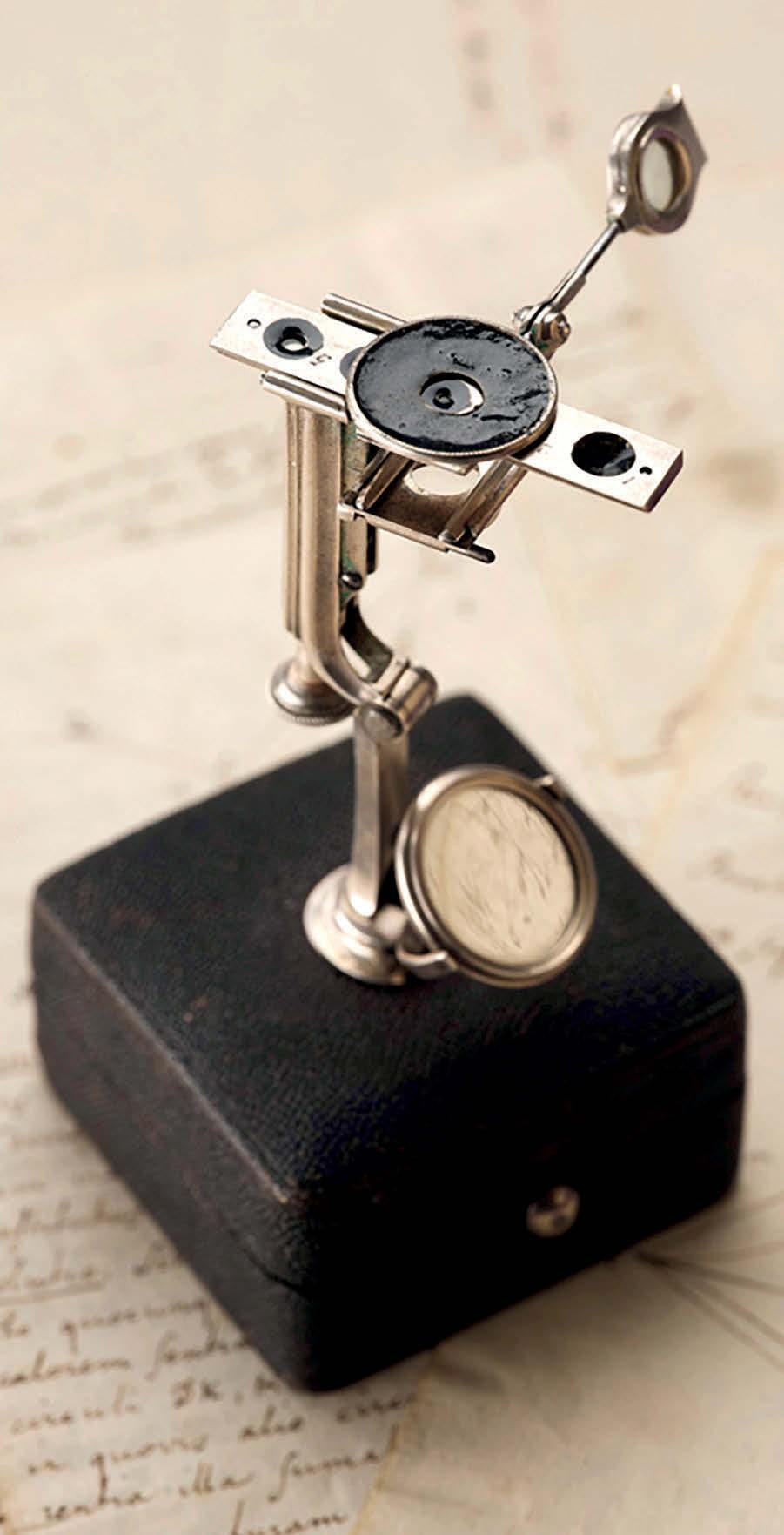
George II cased silver simple ‘pocket’ microscope by John Clark, Edinburgh c.1749-54, sold for £34,000 at Lyon & Turnbull.
It was bought at the Lyon & Turnbull (27% buyer’s premium) auction on October 23 by a Dutch ATG reader who runs his own museum in Utrecht open to the public.
John Clark, a Scottish goldsmith, jeweller and optical instrument maker, was the first Edinburgh instrument-maker to publicise his wares through the medium of the press.
His beautifully made silver ‘simple’ microscopes were aimed at the gentleman amateur at a time when science was becoming a popular leisure pastime. They are considered some of the earliest scientific instruments to be designed, manufactured and retailed outside London.
Clark advertised twice for subscribers for his first microscope model priced at five guineas in 1749 and 1751, and again in 1754 for an updated version priced at four guineas. On each occasion he stipulated a minimum of 50 purchasers (plus down payments) would be required before batch manufacturing would commence.
Only a handful of ‘1749 model’ instruments appear to have survived. One was acquired by the National Museums of Scotland at a cost of £6000 in 1984 with another (the example pictured in DJ Bryden’s 1972 book Scottish Scientific Instrument-Makers 1600-1900) sold by Sotheby’s in May 1966.
Both are signed John Clark Inv. & Fec. Edinb.
The example at Lyon & Turnbull came for sale in Edinburgh as part of the James Stirling library, a group of 18th century books, letters, notebooks and instruments that have come by family descent. While some of Stirling’s manuscripts were published in the 20th century, the Edinburgh auction was the first time the collection in its entirety had been fully catalogued and exposed to public view.
Provenance appeals
It was the rich ‘one owner’ provenance that appealed most to Bert Degenaar, the buyer of the lot. A former dealer, he turned his lifelong fascination with historical scientific instruments into the Zuylenburgh Collection, a public museum devoted to the history of science in an 18th century house of the same name in Oud-Zuilen, Utrecht.
The focus of the collection – recently designated of national importance – is 17th and 18th century instruments and astronomical clocks from Britain and the Netherlands.
More pieces, including a silver microscope by the ‘father of microbiology’ Antoni van Leeuwenhoek (1632-1723), are on semi-permanent loan to the Rijksmuseum Boerhaave in Leiden.
“We have quite a complete collection but when something like this turns up you have no choice,” Degenaar told ATG. He was comfortable with the price although it was many times the estimate of £3000-4000.
The Zuylenburgh Collection owns examples of Clark’s two other known microscope models.
Degenaar purchased a silver microscope matching the specifications described in the 1754 advertisements for £4200 at Charles Miller’s auction in London in November 2024. It is inscribed Willm. Cramlington Esqr, Alderman, Newcastle for William Cramlington (1725-1810), a Newcastle industrialist who was made sheriff of the city in 1775 and mayor in 1796.
Clark issued his third ‘new improved pocket microscope’ in 1773 priced four guineas. Made in conventional brass rather than silver, an example sold for £13,000 at Christie’s in April 2004.
Inspired by Newton
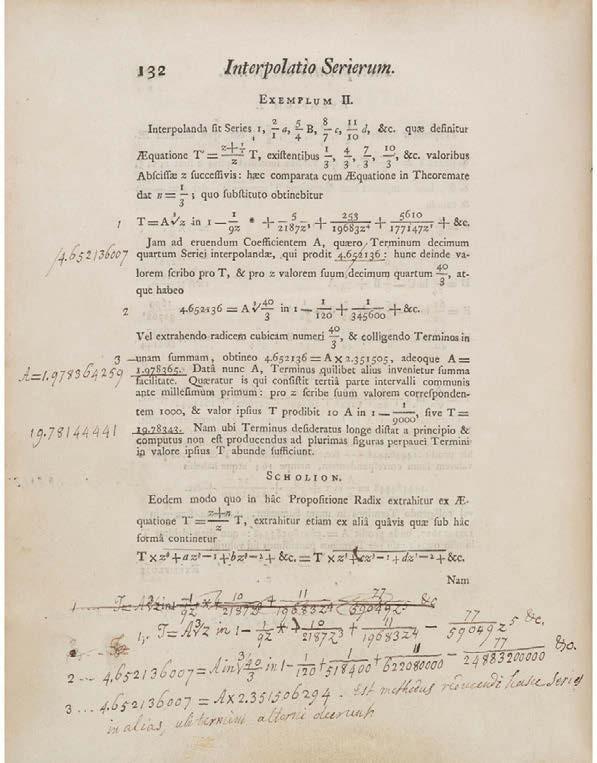
James Stirling’s personally corrected first edition of his Methodus Differentialis, published in 1730, £40,000 at Lyon & Turnbull.
The principal contribution James Stirling made to the history of mathematics is the paper Methodus Differentialis first published in 1730.
Building on the ideas of his mentor Issac Newton, it contains both a discussion of what are now called Stirling Numbers (important in modern combinatorial theory) and a version of Stirling’s Formula for approximating factorials (an early example of an asymptotic series).
Stirling’s library included two remarkable copies of Methodus Differentialis: his holograph manuscript and his personally corrected first edition in Latin.
The 64-page holograph manuscript, written in ink on loose leaves c.1730, covers the published text together with Stirling’s instructions to the printers. He notes: “I kept the boy above a quarter of an hour here; send me the rest of the Leaves that are printed off & a proof of this as soon as you can, because I must look it over and see if there are any Errata.” It hammered at the lower end of a £40,000-60,000 guide.
Stirling’s personal working copy of the book published in 1730 sold at £36,000. In addition to the ownership inscription to the title page, the work featured four pages of autograph annotations to the rear blanks and autograph marginalia to some 50 pages, ranging from corrections of typographical errors to substantial additions to the text.
Stirling’s own copies of landmark works by his contemporaries provided some of the sale’s highest prices.
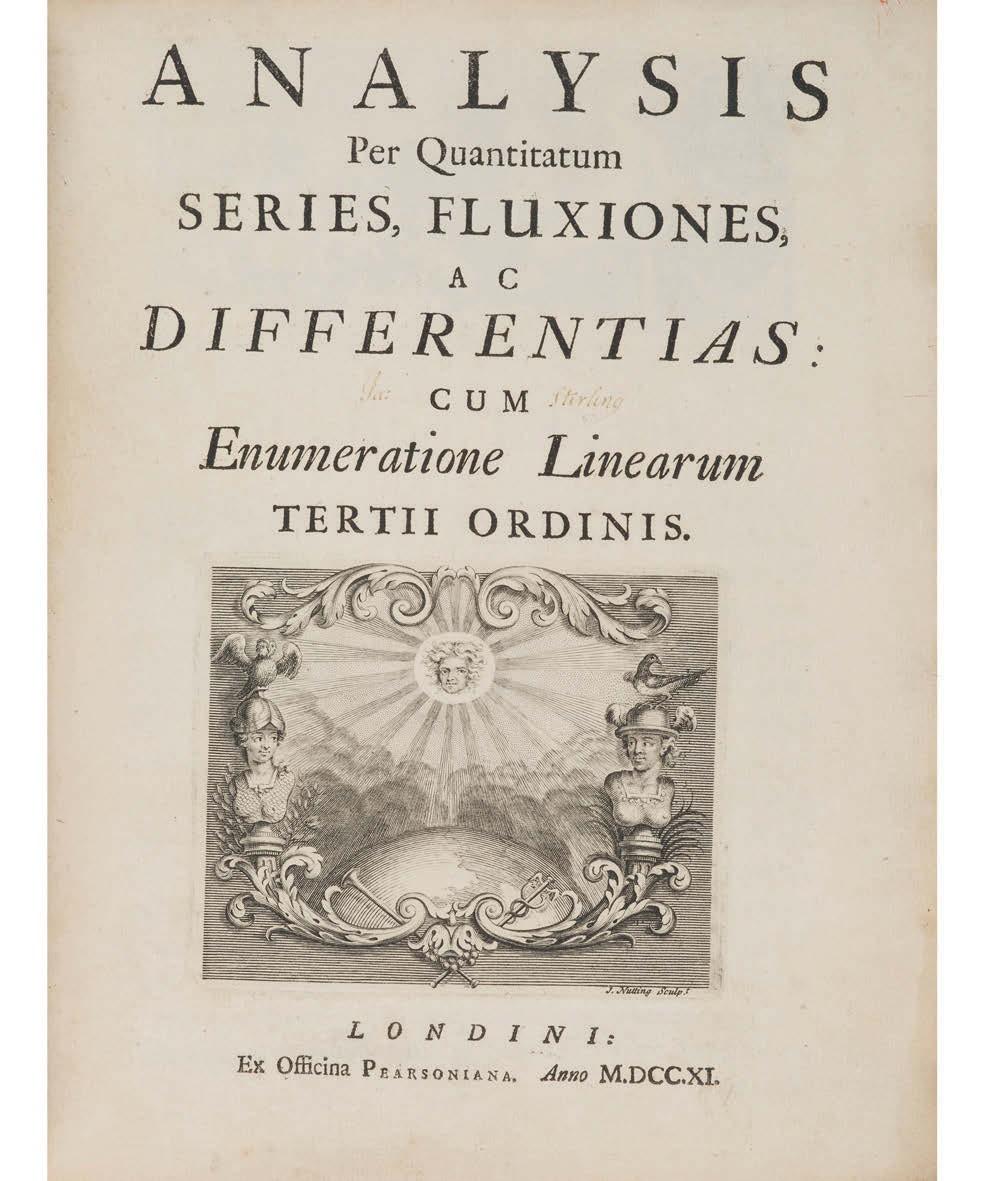
James Stirling’s personal copy of Isaac Newton’s Analysis per quantitatum series published in 1711, £80,000 at Lyon & Turnbull.
Sold at £80,000 was a first edition of the 1711 Analysis per quantitatum series, fluxiones, ac differentias, a collection of Isaac Newton’s mathematical writings published with the intention of establishing his priority over German polymath Gottfried Leibniz (1646-1716) in the discovery of calculus. At the time the decade-long intellectual controversy over which man had discovered calculus was at its peak.
Edited by Welsh mathematician William Jones, Analysis per quantitatum contains the first editions of two foundational works. De Analysis per aequationes numero terminorum infinitas, written in 1669, is considered the ‘first independent treatise on the higher mathematics’, while Methodus differentialis from 1676 concerning the calculus of finite differences inspired Stirling’s later work.
His ownership inscription, Ja Stirling, is found on both the title page and front pastedown, accompanied in the latter case by his note of the price paid (13 shillings) and his purchase of the book in Oxford, where he matriculated at Balliol College in January 1711.
Although he left Oxford without a degree (he is thought to have been sympathetic to the 1715 Jacobite Rising), Stirling received much-needed financial assistance from Newton while a student in Venice and once back in London called on him regularly during his final years. In a letter from 1725 he wrote: “Sr Isaac Newton lives a little way of in the country. I go frequently to see him and find him extremely kind and serviceable in everything I desire, but he is much failed and not able to do as he has done.”
The 160 lots generated a multi-estimate total of nearly £820,000 (including premium), with a 90% selling rate and bidders participating from six continents.