

The term ‘bantam work’ emerged in the late 17th century to describe a style of Chinese lacquer work shipped to Europe through the Dutch trading port of Bantam in Java.
These colourful cabinets and screens, fashioned with layers of carved gesso and vibrantly painted lacquer, were highly prized in the William and Mary period.

Documentary William and Mary period bantam work cabinet and stand, £31,000 at Trevanion.
The example that emerged for auction at Trevanion (24% buyer’s premium) in Whitchurch, Shropshire, on October 15-16 was remarkable as a documentary piece and for the condition of its interior.
While the colour to the exterior was visibly faded, the 15 internal drawers were a blaze of polychrome birds, floral sprays, and figures. To the interior of the doors was the inscription Sarah Eades, Anno Dom 1691 suggesting it had been commissioned to mark a birth or a wedding. The japanned stand, measuring 4ft 7in (1.38cm), wide is later but probably Georgian.

Documentary William and Mary period bantam work cabinet and stand, £31,000 at Trevanion.
Christina Trevanion from the auction house said the cabinet had been an unexpected find during the clearance of a Pembrokeshire stone cottage. After learning of the level of pre-sale interest his late mother’s cabinet had generated at its £2000-3000 guide, the owner made the journey to Shropshire to watch the auction in person.
It went to a Dutch bidder via thesaleroom.com at a hammer price of £31,000. That appears a strong price; while bantam cabinets occasionally appear at country house sales, most have sold in the £10,000-20,000 range.
Handy for extra guests

Regency period mahogany radially expanding dining table, £30,000 at Trevanion.
A still desirable 19th-century furniture type is the metamorphic radially expanding dining table.
These designs appeal now as they did in the William IV and early Victorian age: the addition of sets of leaves allows for a circular table of different sizes that is perfect for good dinner party conversation.
The most coveted of these, that expand from a common centre via an ingenious wind-out mechanism and a series of extra leaves, follow the patented design filed by Robert Jupe in September 1835. However, while a great Jupe table might cost close to six figures (Lyon & Turnbull sold one in November 2022 for £120,000, see ATG No 2571), less sophisticated variants on the theme were – then as now – a little more affordable.

Regency period mahogany radially expanding dining table, £30,000 at Trevanion.
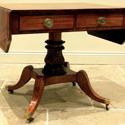
An example at Trevanion, with handsome late Regency styling to the base, has manual pullout lugs to support four large numbered crescent-shaped leaves. The top, formed in two sections, measures 4ft 10in (1.75m) when ‘closed’ and 6ft 10in (2.07m) when ‘opened’. Unusually, the table has a tilt-top mechanism allowing it to be stored in the corner of a room when not in use.
The table came for sale from a Cheshire country house where it had been all its life and a £400-600 guide ensured plenty of pre-sale interest. It will need some time with a restorer to attend to some age repairs and disparity of colour between the faded top and the untouched leaves. However, it required a bid of £30,000 from a north of England buyer to secure the prize.
“Any auction where a piece of furniture sells for £30,000 is unusual these days, but it’s a mistake to dismiss furniture as the poor relation in the auction world – top-quality pieces will always sell well,” said Trevanion.
Heir lift

Early 18th century English press moulded slipware dish, £11,000 at Trevanion.
A third five-figure bid was provided by an exceptional 14in (35cm) diameter slipware dish consigned from a Shropshire vendor whose late father had told her it would be ‘her inheritance’. Guided at just £200-300, it hammered in the room at £11,000.

Early 18th century English press moulded slipware dish, £11,000 at Trevanion.
“When the lot opened, I had international online bids flashing away in front of me so fast that it took me a moment to notice our room bidder,’ said auctioneer Simon Grover.
“But as soon as he started bidding, I could tell that he wasn’t going to leave without it. The buyer was local to us in south Cheshire, so the bowl won’t be travelling too far.”
While the auction house suggested it was among the distinctive group of dishes with trailed slipware decoration made by Ralph and Thomas Toft in the 1670s-80s, it was probably a little later.

Early 18th century English press moulded slipware dish, £11,000 at Trevanion.
A number of similar press-moulded dishes are known including those marked SM for the Lazencroft Manor, Leeds and Burslem potter Samuel Malkin (1668-1741). The Staffordshire potters John Simpson (1685-1775) and Thomas Wedgwood (1685–1739) are also thought to have made similar wares.
Some fine examples dated to the first and second quarters of the 18th century featured in the opening sale of Syd Levethan’s Longridge collection sold by Christie’s in 2011. In this case, the design of two gauntlets to the well within a border of four stylised lions and four fleur de lys appears to have been inspired by Near Eastern metalwork or European tin-glazed earthenwares.
The piece was in relatively good condition, although a section to the rim had been broken and repaired.
Under £500
As with many UK regional sales, the core of this two-day offering was provided by good quality, interesting antiques and collectables priced from £50-500. A selection of these appears here.