
They were consigned to the Essex saleroom by three of his great-great grandsons.
It's hard to think that the V&A's 1994 show Pugin: A Gothic Masterpiece, which included these same pieces, was the first significant exhibition devoted to Pugin since 1851. As Paul Atterbury noted in the Sworders catalogue, the exhibition had the aim of of restoring Pugin to "his rightful place in the hierarchy of design history after a century of neglect".
And achieve its aim it did. Prior to that, Pugin was known to history of art graduates and pub-quiz enthusiasts as Barry's co-designer of the Houses of Parliament. Today he is a household name in any reasonably educated house and hugely admired. Prices for Pugin-designed works of art have perhaps quadrupled in price over the two decades leading up to this year, the bicentenary of his birth.
Star Lot
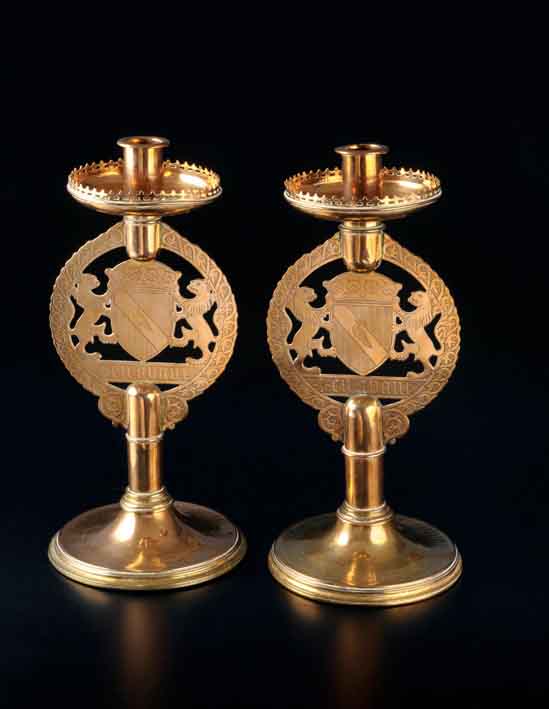
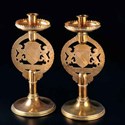
The star attraction at Sworders was a superb pair of 13¾in (35cm) tall, gilt brass candlesticks manufactured c.1844 by Pugin's trusted friend John Hardman of Birmingham and was estimated at £7000-10,000.
Engraved with Pugin's coat of arms featuring ravens, and supported by the lions from the arms of his third wife Jane Knill (the vendors' great-great grandmother), the sticks, like so much of Pugin's work, had an ecclesiastical air to them and were engraved en Avant (forward) and Domine da Novic Lucem (Lord, give light to the novice).
The London trade locked horns before the pair finally sold over the phone at £68,000 to Blairman & Sons of Mayfair, who include Gothic Revival among their specialties.
Blairman director Martin Levy said afterwards: "It was an absolutely iconic pair, the sort of lot which may never appear again. If the V&A were ever to have another exhibition the candlesticks would be an ideal choice for the catalogue cover."
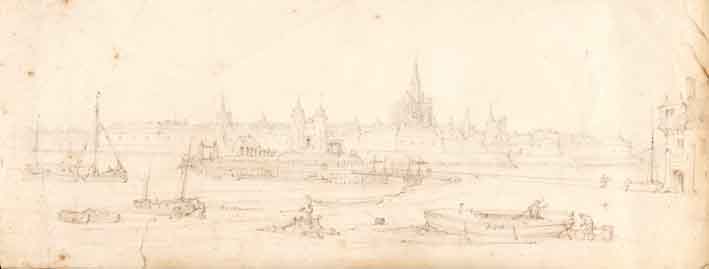
Mr Levy, who had coveted the sticks since going down to Essex to see them, would not be drawn as to who the eventual owner might be but did admit to buying a small Pugin pencil sketch at £1300 "as a present to myself".
The interest of top-end specialists at the view had been encouraging but tight-lipped. Sworder's George Schooling said: "The trade knew all about the items but kept their cards very close to their chest right up until the last minute."
Another London specialist took two other top lots from the 16-lot section.
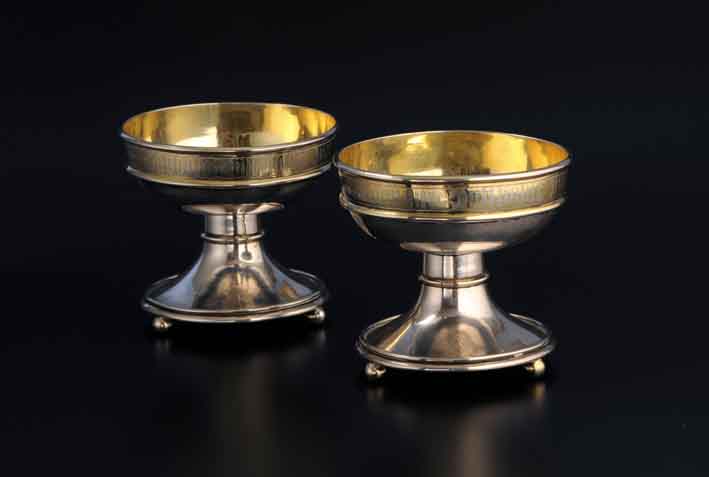
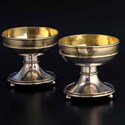
One, a pair of silver salts with gilt interiors, also manufactured by Hardman c.1838, had an altar-table look - they could have passed for Communion chalices, albeit very small ones at 4in (10cm) diameter.
They were engraved to the rim Without me there is no savour. Was this a mildly sacrilegious Pugin pun on Isaiah: 'I am the Lord; and beside me there is no saviour'? Did the great churchman (he designed six cathedrals and about 40 churches in his short-lived career) have a sense of humour at home at The Grange?
On a more elevated note, the salts, like all the Pugin pieces, "offered a rare insight into the things he chose to live with at home", as Antiques Roadshow expert Mr Atterbury commented.
They took £13,000 against a £3000-5000 estimate.
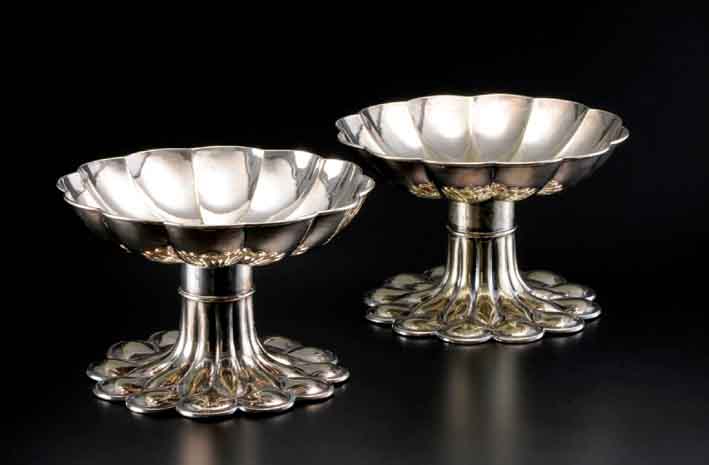
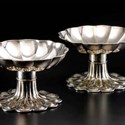
Also estimated at £3000-5000 but selling at £19,000 to the same dealer was a pair of 6¾in tall, 10½in wide (17 x 27cm) silver-plated tazzas by Hardman, c.1846, with lobed bowls featuring central roundels engraved with knights' helmets and foliage and the stems and outswept bases also with lobed decoration.
One Pugin piece to go below hopes was lot 572, a pair of 12½in (32cm) gilt-brass candlesticks (Hardman c.1846). Estimated at £5000-10,000, one of the pair was missing its sconce and, with trade bidders demanding perfection, this was a private buy at a very reasonable £3400.
Other lesser Pugin pieces generally doubled their estimates, including a 5in (13cm) tall silver-plated beaker offered with an 8¾in (22cm) diameter platter, both c.1846, taking £1300; a 10¼in (26cm) tall gilt-brass altar vase with enamelled plaque front, probably for use in Pugin's private chapel, going at £1200, and a pair of silver-plated, lidded storage jars with Pugin's crest to the bases making £2800.
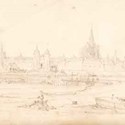
As well as Mr Levy's present to himself - a 5 x 13¾in (13 x 35cm) pencil sketch of a riverside walled city, possibly in Germany, at £1300 - there was an inscribed watercolour of the Bishop's Palace, Beauvais, which went a shade over hopes at £1800.
The one failure in the £114,000 collection was not, in fact, a Pugin design, but a silver teapot by Samuel Hayne and Dudley Cater, London 1843. It bore the Pugin family crest as its enamelled finial but was probably bought for the house by Pugin's second wife, Louise, and was bought in against hopes of £3000-5000.
Coronation Bow Tie
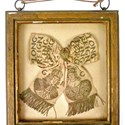
Pugin's pride in his family appears to have triumphed over his aesthetic tastes in the case of a bow tie which hung mounted and framed at The Grange. It was worked in silver threads with portraits of George III and Queen Charlotte and Long Reign King George and was the Westminster Abbey neckwear of a London lawyer.
It is inscribed on the back of the mount in what is believed to be Pugin's hand: Worn by my grandfather Welby Esq of the Middle Temple at the Coronation of George III AD 1760. Estimated at £400-600, it sold to a London dealer at £1150.